Beware of Other License Plate Surveillance Companies Besides Flock
There鈥檚 a nationwide rebellion against license plate readers underway, and the company Flock is the focus. That鈥檚 natural, because the company has 鈥� license plate recognition across the United States,鈥� as industry analyst IPVM put it. But Flock is far from the only vendor, and with Flock rightly receiving most of the heat, it鈥檚 important to realize that its competitors aren鈥檛 so great either, and that simply replacing Flock surveillance with another company鈥檚 surveillance won鈥檛 necessarily solve any of the privacy and other civil liberties problems posed by this mass surveillance technology.
We have covered Flock in depth, including in this 2022 white paper and in numerous blog posts since. A pioneer of centralizing ALPR data through the cloud, the company runs a vast 鈥淣ational Lookup鈥� searchable nationwide database of license plate and other photographic data of vehicles 鈥� an inherently authoritarian infrastructure that has, among other things, already been used to help ICE in its human rights-violating deportation drive, and to try to track and investigate a Texas woman who had an abortion.
Aside from being dominant in the domestic police ALPR market, Flock is also alienating many communities because of its lack of truthfulness and and immature public statements. Unlike its biggest competitors, which are public companies, Flock鈥檚 private investors include tech billionaire venture capital firms such as Andreessen Horowitz, which also funds other surveillance companies like and , and domestic law enforcement surveillance capabilities. These are legitimate reasons to avoid doing business with a company.
At the same time, communities can鈥檛 simply assume that their residents will be better off from a privacy and civil liberties perspective by dropping Flock and replacing it with another ALPR provider, as some customers have done. They should ask hard questions about whether they really want to create that kind of a system, and if they do, ensure it doesn鈥檛 function as a mass surveillance system.
Motorola Solutions (aka Vigilant)
One of Flock鈥檚 most significant competitors is Motorola. This company, which has been expanding its police technology offerings through an aggressive acquisition strategy in recent years, offers a nationwide law enforcement data sharing system similar to Flock鈥檚 called the National Vehicle Location Service (NVLS), operated by Motorola unit Vigilant Solutions. In addition to collecting data from law enforcement clients鈥� cameras, it also runs a large separate commercial ALPR unit that makes deals for tow trucks and other fleet vehicles to carry cameras and collect data for Motorola as they drive around, billions of plate reads (a claimed 500 million , subject to no apparent data retention policy). Known as the Digital Recognition Network (DRN), that unit sells its data for commercial purposes but also makes it to its law enforcement customers for an extra charge. Motorola agencies they can have 鈥渁ccess to billions of detections beyond your own,鈥�
Some communities may want to take into account the fact that this uniquely powerful commercial plate-scanning infrastructure is marketed to private companies, including auto financers and insurers, and not only for repossession but also for 鈥渞isk assessment鈥� purposes 鈥� even though have been shown to low-income and other marginalized drivers.
(Note that following a 2011 corporate breakup of the classic American electronics company ., the company Motorola Solutions being discussed here is separate from Motorola Mobility, a smartphone owned by the Chinese company Lenovo.)
Axon
Formerly known as Taser, Axon has built its business around that police pain-delivery device, as well as body cameras, where it dominates the market, and its cloud data storage service Evidence.com. Like Flock and Motorola, the company is seeking to become a broad 鈥渙perating system of police departments,鈥� which has ominous implications we detailed in a recent white paper. Axon has been aggressively expanding its law enforcement products, including by pushing premature uses of AI. Many Flock customers already have contracts with Axon for body cameras and other products, making a switch to Axon all the easier 鈥� especially since Axon is pursuing an explicit of bundling multiple technologies and services together in long-term contracts. That raises significant over platform dependence and lock-in.
As part of these strategies, Axon is looking to build up its ALPR offerings 鈥� and the market for them, which (as the 桃子视频has seen firsthand) has included lobbying against state ALPR regulations and local surveillance tech transparency laws. The company began selling ALPR services in 2021 its in-vehicle 鈥淎xon Fleet 3鈥� dashcam and in-car camera product, and then in 2025 new fixed-camera ALPR products, including a 鈥渟mart streetlight鈥� that attaches to existing poles and power sources. Both products AI vehicle recognition. Axon doesn鈥檛 impose any limits on its customers and lets police departments decide how long they want their data to sit on Axon鈥檚 servers. It does have a default policy of 30 days, but that鈥檚 only a default.
All three companies offer products that blur the lines between ALPR and live video surveillance. 鈥淵ou no longer have to make tradeoffs when it comes to ALPR deployments 鈥� license plate recognition or livestreaming,鈥� Axon .
It鈥檚 not clear whether Axon has any formal arrangements with ICE or other DHS agencies to access plate-read data collected by Axon devices, though the company does have a number of contracts with the federal government, an announced $220 million five-year deal to buy the company鈥檚 problematic Taser devices. That does not have the same privacy implications as sharing data on people鈥檚 locations with ICE, though supplying that agency and its often lawless and abusive officers with Tasers may violate the company鈥檚 responsibilities under internationally recognized human rights standards, and generally carries a moral stench.
Axon is itself as a 鈥渕ore ethical鈥� alternative to Flock. As the security industry analysts at IPVM put it in a headline, 鈥淎xon LPR Business Surges As Flock Is Embattled.鈥� Axon has a particular rivalry with Flock over becoming a broad provider of police surveillance and data services 鈥� the 鈥渙perating system of police departments鈥� (with Motorola also in the running in a less high-profile way). I looked at that race and its implications in a June 2026 white paper.
Other companies
There are a lot of other ALPR vendors. The DHS Science and Technology division, in a rudimentary Consumer Reports-style for police, lists 16 different providers. In February, IPVM tests of ALPR accuracy and included nine products; another analyst 46 vendors in the ALPR space.
One provider, Rekor, provides ALPR services to the Westchester County, NY police, which is the of a class action by the New York Civil Liberties Union and other groups. Rekor offers rich vehicle AI searches as well as video clips of vehicle captures. It鈥檚 unclear whether the company has a current contract with ICE, but documents obtained by the Associated Press in 2025 that CBP had had access to data from Flock, Motorola, and Rekor. Documents obtained bythe Guardian also that Rekor鈥檚 client, the Westchester County PD, has shared data with ICE; it鈥檚 not clear whether that Rekor facilitated or continues to facilitate that sharing. Rekor has a nationwide data like Flock and Motorola, though it is much smaller at this time. Unlike Flock and Motorola, the company for local software installation and data processing by clients.
The provider Leonardo (selling an ALPR product called ELSAG) also for its system to be run on local hardware. ELSAG has attracted attention lately due to a very that it advertises: the tracking not only of license plates but also of devices through their Bluetooth and other wireless emissions. It reads unique IDs broadcast not only by phones but also by tablets, laptops, and any other wireless-capable objects that might happen to be in a car, as well as wireless components of the car itself, such as audio-video systems and the Tire Pressure Monitoring Systems that all cars are now required to have, which use Bluetooth. That鈥檚 an extremely powerful capability that in many cases will supercharge the tracking of individual people including passengers 鈥� and we should hope this 鈥渋nnovation鈥� doesn鈥檛 spread to other vendors.
Most other ALPR vendors are small, and based on a non-systematic review of a sampling, often don鈥檛 offer some of the more troubling capabilities that their larger competitors do 鈥� though there are exceptions (such as the many advertising cutting-edge AI, for example).
The big network-effects advantage that Flock and Motorola have over their smaller competitors 鈥� the size of their customer/data sets 鈥� gets erased if communities decide to ban nationwide sharing. If you鈥檙e collecting and storing your data locally and generally keeping things simple, the smallest ALPR vendor out there may serve just as well as the bigger names. Companies like Flock, Axon, and Motorola are competing by offering to make law enforcement ever-more powerful and all-seeing; good civil liberties protections will have the effect of making ALPR devices and services much more commodified and interchangeable 鈥� something tech companies hate but which serves the public better.
Civil liberties differences
There are differences among the leading US license plate reader companies on the dimensions important to privacy and other civil liberties.
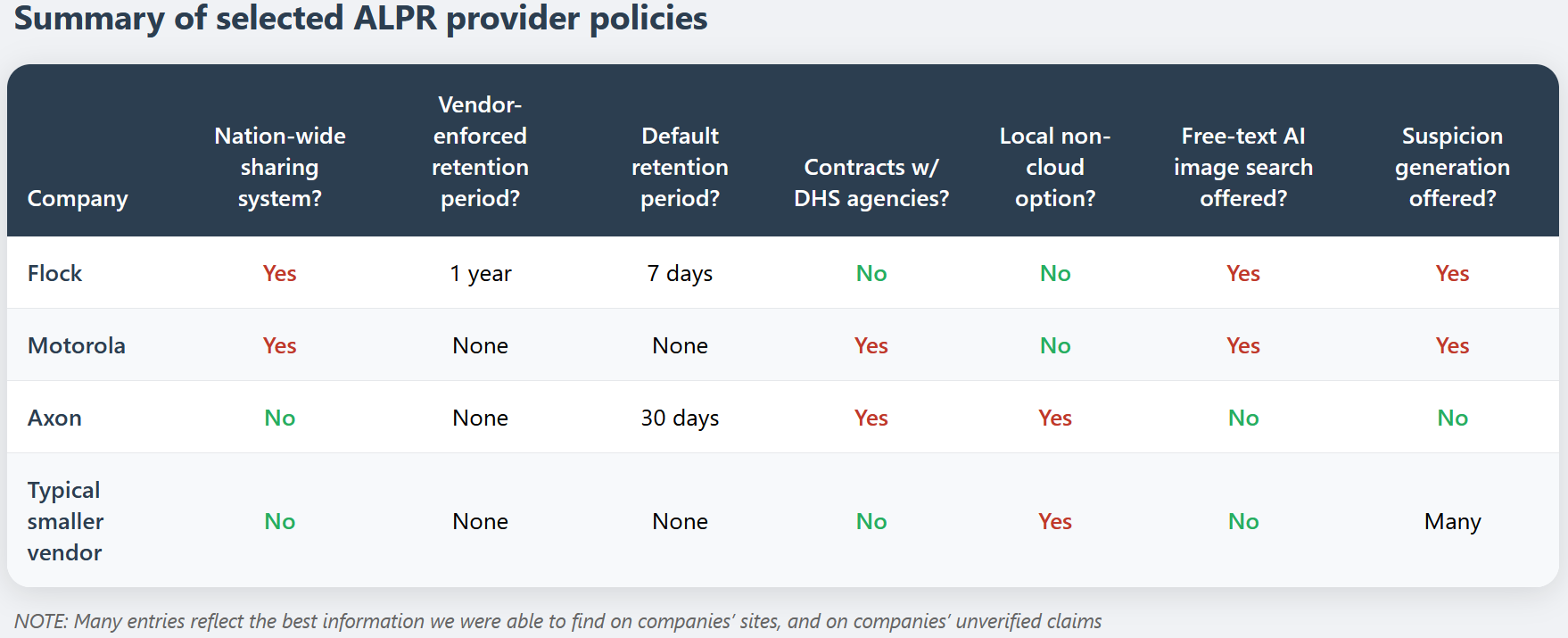
- Nationwide sharing. Nationwide sharing of the kind that Flock provides significantly increases the scope and power of ALPR surveillance compared to purely local surveillance carried out by a particular police department. Preventing such sharing has been one of our primary recommendations for communities. Flock 75% of its 5,000 police customers in the company鈥檚 National Lookup network, making it an extremely powerful surveillance machine. Motorola seems to have fewer police clients than Flock but 鈥� in part due to its commercial DNR network 鈥� boasts of an enormous number of monthly plate reads that can be accessed as part of its NVLS sharing service. It鈥檚 hard to find data on their relative market shares, but these networks give their operators an enormous business advantage over smaller competitors among departments that want the nationwide search capability they offer. Axon has an ALPR data sharing built into its search tool, but that appears to require an explicit department-by-department agreement to engage in such sharing.
- Retention periods. How long police departments hold on to the potentially sensitive data about ordinary people鈥檚 lives that license scanners collect is a key civil liberties metric. Where police use ALPR we recommend a rule like New Hampshire鈥檚, in which plate reads that don鈥檛 result in a watch list 鈥渉it鈥� must be deleted within three minutes, or failing that, a retention period of no more than 48 hours. But the leading vendors all allow their customers to retain their ALPR data for as long as they like, with the exception of Flock, which it imposes a one-year limit, and requires 鈥渁pproval from an elected official and/or a governing body鈥� to retain data for more than the company鈥檚 7-day default retention period. Otherwise, default retention periods amount to no more than suggestions. With a network as large as Flock鈥檚 (a 20 billion monthly plate scans), a 7-day retention period (which the company announced with great fanfare in an attempt to quiet opposition) still gives police departments far too much mass-surveillance power over people not suspected of wrongdoing. In the absence of vendor-imposed limits, customers may decide on very long retention periods; the NYPD, for example (which uses Motorola), its ALPR data for five years.
- Federal sharing. Flock says it doesn鈥檛 have any contracts with ICE or other federal agencies, though it has become clear that those agencies can access the company鈥檚 ALPR database through in local departments. (In August 2025, Flock was to have been sharing data with CBP through an undisclosed pilot project, since .) At the end of the day, once data about the lives of ordinary people in a community is collected, it鈥檚 very hard to control. Motorola, however, has a contract ( Thompson-Reuters) permitting that agency to directly search Motorola鈥檚 surveillance database, so if your police department is contributing to that, you know your data is going to ICE, no intermediaries required.
- Cloud and local storage and control. In addition to all the questions raised by license plate surveillance, there are serious questions about private company access to that data, as we outlined in a recent white paper. Local storage also offers more local control 鈥� if the data your local department collects is stored on its own computers and not accessible by the vendor, for example, then the vendor鈥檚 policy on sharing with ICE is no longer an issue. Local storage of data on police department鈥檚 own computers used to be common with ALPR systems, but today, with the trend toward cloud services, neither Flock nor Motorola allow their clients to store their data locally. Both claim to allow their customers 鈥渃ontrol鈥� over their data, but that is a governance claim and not an infrastructure claim, and ultimately whoever holds the data truly controls it (unless it鈥檚 end-to-end encrypted). Axon does a local storage solution, as do some other competitors, as discussed below.
- AI imagery search. Since its inception, basic license plate detection has collected license plate number data, snapshot stills of plates, and place/time data, but companies are now promising police departments new powers by pushing far beyond that. We recommend that communities require any ALPR vendors to stick to the basics. All the companies offer analysis of vehicle attributes, and some also offer more powerful free-form AI search of stored video or still imagery. Flock touts its ability to let officers search not just for license plates, but also for make, model, and other vehicle attributes and distinguishing characteristics, and to use free text AI searches to unleash modern video analytics not just for vehicle searches but also for people appearing in captured imagery. Motorola also collects other data about vehicles (but not people), 鈥渁ccessories, damage, and promotional writing or bumper stickers,鈥� and plain-language AI search of the imagery in its database. Axon offers structured for various vehicle attributes but doesn鈥檛 have the same level of wide-ranging AI search (except for within case files). It鈥檚 likely that whatever particular companies offer now, however, many or all will eventually offer such capabilities.
- Suspicion generation. Here Flock is definitely the worst, touting the ability to 鈥渄etect patterns of suspicious activity across cities and states,鈥� and generally opening up unprecedented new possibilities for fishing expeditions by allowing through data on people鈥檚 movements. Motorola also crosses that key line from investigative aids to generation; touting its ability to 鈥渞eveal patterns, trends and associations which generate leads.鈥� It doesn鈥檛 seem that its system aims to facilitate a true cold search for movement and association patterns to the extent of Flock. Axon doesn鈥檛 appear to offer suspicion generation capabilities at this time. But again, the various vendors鈥� AI offerings may change fast.
- Use of NCIC database. One key civil liberties protection around plate scanning is that the watch lists used by law enforcement be subject to checks and balances. Flock鈥檚 service runs plate scans against the FBI鈥檚 criminal database, the NCIC. It is murky exactly how this access works 鈥� the FBI refused to explain it to the author of an IPVM on the subject 鈥� but as we have explained, it鈥檚 problematic for a number of reasons having to do with accuracy, due process, and timely updating of listings of which cars are flagged. In addition, one component of the NCIC is an 鈥淚mmigration Violator鈥� hotlist maintained by ICE, which can be a of enabling local police to cooperate with the Trump Administration鈥檚 deportation drive. In addition to Flock, can also run their hits against this database. I wasn鈥檛 able to confirm whether Motorola also allows that functionality. At least of the smaller companies appear to
Another potential check on the power of ALPR systems is use limitations. Flock has in the past promised to restrict 鈥渋mpermissible鈥� searches, such as abortion-related searches in states like Illinois that ban the sharing of abortion data. More recently, the company announced as part of its 鈥渦pdates鈥� meant to mute criticism that it would let local departments decide what types of offenses other Flock customers can search their data for. The problem is that there is no effective enforcement mechanism behind these measures; they rely on an honor system in which police officers accurately and honestly describe the purpose of their search 鈥� something that experience has to be .
What matters most is not maximum capabilities but actual deployment contracts
As we have seen, there are significant differences among providers in how license plate scanning is done. But a community can often reach a contract with providers that restricts the capabilities that are deployed. For several years we have urged cities to do this. Just because Flock and Motorola do nationwide sharing and AI search doesn鈥檛 mean that a police department needs to use (or a city council needs to allow its police department to use) such capabilities. Defaults are important, but for a jurisdiction that is determined to deploy ALPR, the most important differences among companies that community members should look at are what those vendors will allow localities to control.
Community members attuned to privacy and civil liberties should also push city councils 鈥� or state legislatures 鈥� to put limits into law through general ordinances that remain in effect even as contracts and vendors come and go over the years. The differences among vendors in how they provide ALPR services are governed by corporate strategy rather than law, which means they can be changed in an instant by the companies. Communities should not gain too much comfort from what companies are and are not doing right now, but instead keep their eye on the longer game by putting protections into law.
When Denver decided to its contract with Flock earlier this year, it () switched to a new vendor (Axon). But what mattered more than the change in vendor was the change in how ALPR was operated; the new contract shortened the data retention period (from 30 days to a still-too-long 21 days), restricted data sharing, and banned federal access to Denverites鈥� data. Denver probably could have obtained those same terms with any vendor.
Overall, the default behavior of a company鈥檚 ALPR offerings becomes less important, and the control it gives customers becomes more important.
- Choosing a short retention period. Motorola and Axon allow a customer to retain data for as long as they want, and despite its new suggestion of 7 days, down from 30, Flock only hard-caps retention at a year. But customers of all three companies (and, my sense is, their smaller competitors鈥�) can still set very short data retention limits as we recommend.
- Disallow nationwide sharing. Flock and Motorola, which both offer nationwide data sharing, both allow customers to not participate (but often cajole them into participating, because it is in the companies鈥� financial interest for them to do so). Note, however, that vendors also can allow regional, statewide, or department-by-department sharing, so access to your community鈥檚 data can be fairly broad even without nationwide sharing. Axon doesn鈥檛 offer nationwide sharing but does have built-in functionality for case-by-case sharing among departments. The more broadly data is shared, the more points there are for ICE, CBP, or anyone else to access it through a cooperative department or officer.
- Choosing local data storage. On the other hand, when it comes to local data storage, a Flock or Motorola customer doesn鈥檛 have the option to not use their cloud services so far as we can tell, whereas customers of Axon, Rekor, and other vendors do.
- Decline AI analytics. It appears that police department customers can鈥檛 opt out of basic vehicle attribution recognition capabilities offered by all the biggest companies. The freeform AI searches of still and video data that Flock offers to be a separate product that a customer could simply decline to pay for. It鈥檚 less clear whether customers can opt out with Motorola, but the company may be willing to agree to disable that functionality to make a sale.
- Decline suspicion-generating AI. As far as we can tell, use of Flock and Motorola鈥檚 AI algorithmic suspicion-generation is not required, so in theory a municipality could insist through an ordinance and in vendor contracts that such a capability not be made available to a client police department.
The bottom line
Overall, a comparative look at the ALPR marketplace through a civil liberties lens yields several takeaways:
- If a jurisdiction decides to allow license scanners to be installed, how that system operates is more important than which vendor provides it, though considerations about the overall ethics of a company are certainly worth taking into account.
- When looking at vendors, the most important question is whether they provide the option to impose restrictions that protect privacy and civil liberties.
- If a community doesn鈥檛 impose strong conditions such as data retention limits, switching from Flock to another ALPR provider could leave residents鈥� civil liberties in equally bad or even worse shape.
- Communities should address ALPR policies democratically and they should impose them through legal limits on license scanning rather than through internal police department policies or vendor contracts that will be repeatedly re-negotiated as years pass.
Again, the most civil liberties protective step that a municipality can take is to spurn license plate scanners altogether. But where that鈥檚 not possible, community members should not think that simply abandoning Flock for another vendor will necessarily make things better.
Related 桃子视频
Related Content
-
News & CommentaryAug 2026

Privacy & Technology
Despite 'new' Updates, Flock's Creepy Cameras Remain Major Civil Liberties Threat. Explore News & Commentary.Despite 'New' Updates, Flock's Creepy Cameras Remain Major Civil Liberties Threat
In response to Flock鈥檚 announcement of operational changes, the 桃子视频breaks down why many fall short. -
Press ReleaseAug 2026

Privacy & Technology
National Security
As Public Opposition To Flock Grows, Aclu Responds To Surveillance Company鈥檚 鈥渘ew鈥� Updates. Explore Press Release.As Public Opposition to Flock Grows, 桃子视频Responds to Surveillance Company鈥檚 鈥淣ew鈥� Updates
NEW YORK 鈥� Amid nationwide outcry against its automatic license plate readers, Flock Safety announced today that it will reduce its standard data retention policy and allegedly provide more control over local data searches, among other changes. However, according to 桃子视频鈥檚 new analysis, many of the proposed changes seem to be a thinly veiled PR attempt to counter communities鈥� genuine privacy concerns with its mass surveillance system with largely hollow security promises, rather than an earnest effort to address them. While the 桃子视频acknowledges one potentially positive development, most of the proposed changes stand little chance of making a positive difference for civil liberties. 鈥淭ransforming an exceptionally dangerous mass surveillance system into one that is fully protective of civil rights and civil liberties is a difficult, if not impossible task. That is even more the case with a company like Flock, whose nearly $1 billion in venture capitalist funding has locked it into an operational model that seeks to trade our privacy for massive profits,鈥� said Chad Marlow, senior policy counsel at ACLU. 鈥淕iven that Flock鈥檚 latest announcement still appears more focused on addressing a PR problem than the significant privacy and other harms its products create, we will continue to analyze the company鈥檚 proposals fairly and honestly. We just won鈥檛 be holding our breath.鈥� Flock operates more than 120,000 automatic license plate readers in at least 6,000 cities across the country, raising serious concerns around mass surveillance, data privacy, and how police and the government can use this data to go after immigrants, protestors, and others. Just this week, the Institute for Justice published a database with more than 100 incidents of ALPR abuse, including romantic stalking, wrongful stops and detentions, non-law enforcement use, and other types of misconduct. One of the changes announced is that Flock will decrease its standard data retention option to one week from 30 days. This seems positive at first blush, but as the ACLU鈥檚 breakdown explains, the devil will be in the details. For example, an exception to the data retention policy is something called 鈥淓vidence Mode, which is 鈥渨hen a search is tied to a case number, that data is preserved instead of aging out after 7 days.鈥� As the 桃子视频notes, 鈥淚f 鈥楨vidence Mode鈥� only retains hit result data that police determine may be evidence in an active investigation of a specific case, then the change may be a positive one. But if Evidence Mode triggers the retention of any ALPR data that is searched, then the new mode could indefinitely retain all the ALPR data Flock collects and shares nationally.鈥� Another 鈥渃hange鈥� the company is implementing is that local police will be able to decide what types of offenses other Flock customers can search their data for. The 桃子视频contends that this is not new. Flock has attempted this before, and the security measure failed because police were easily able to circumvent the system鈥檚 requirement that they input the purpose of their search. Finally, Flock announced that in response to the reports of police abuse, they will now require reasons for a search, and that they plan to universally roll out its audit assistance tool to detect police misuse. Flock鈥檚 announcement fails to note how easily users have circumvented 鈥渟earch reason鈥� security measures in the past or how its new policy improves the quality of the feature. And while providing 鈥淎udit Assistance鈥� to all departments makes sense, the 桃子视频notes that there is no evidence that the tool works consistently to address what the Washington Post observed is a growing pattern of police officers turning Flock into a personal stalking tool. To determine the efficacy of this tool, Flock needs to have it analyzed by an independent evaluator. Until then, the 桃子视频says, 鈥渨e don鈥檛 know if the tool is a real security measure or just window dressing.鈥� Dozens of communities across the country have successfully convinced their leaders to cancel Flock contracts, suspend their ALPR programs, or deactivate the cameras, with many more cities considering new legislation to rein in this mass warrantless surveillance tech. In June, the 桃子视频launched its 鈥淕et the Flock Out鈥� campaign to bring together the litigation, advocacy, and legislative efforts of 桃子视频affiliates in each state, show how communities across the country are fighting back against the spread of Flock and other license plate readers, and lay out how lawmakers at the local, state, and federal level can best protect our rights. -
News & CommentaryAug 2026
Privacy & Technology
Immigrants' Rights
Ice Agents To Wear Body Cameras But The Fix Is In. Explore News & Commentary.ICE Agents to Wear Body Cameras But the Fix is In
The technology appears unlikely to constrain the immigration agencies; much more sweeping reforms are needed -
VirginiaAug 2026

Privacy & Technology
National Security
In Re: Application Of The United States Of America For An Order Pursuant To 18 U.s.c. 搂 2703(d). Explore Case.In Re: Application of The United States Of America for an Order Pursuant To 18 U.S.C. 搂 2703(d)