Featured

U.S. Supreme Court
Nov 2025
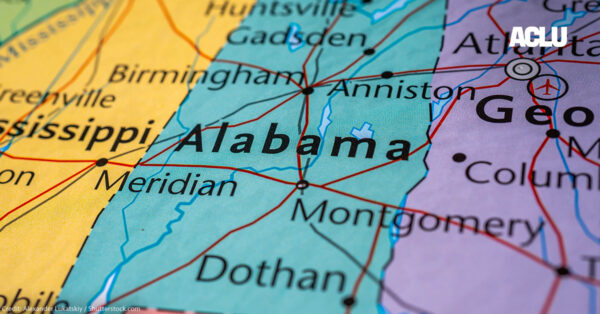
Alabama on a map of the United States of America

Voting Rights

Racial Justice

Allen v. Milligan

Whether Alabama’s congressional districts violate Section 2 of the Voting Rights Act because they discriminate against Black voters. We succeeded in winning a new map for 2024 elections which, for the first time, has two congressional district that provide Black voters a fair opportunity to elect candidates of their choosing despite multiple attempts by Alabama to stop us at the Supreme Court. Despite this win, Alabama is still defending its discriminatory map, and a trial was held in February 2025 to determine the map for the rest of the decade. In May 2025, a federal court ruled that Alabama's 2023 congressional map both violates Section 2 of the Voting Rights Act and was enacted by the Alabama Legislature with racially discriminatory intent.
Allen V. Milligan. Explore Case.

All Cases

29 Supreme Court Cases during the 2022 Term

Skirts
U.S. Supreme Court
Aug 2021

Women's Rights

Peltier v. Charter Day School

This case involves a public charter school in North Carolina that requires girls to wear skirts to receive their state-guaranteed and state-provided education, based on the belief that every girl is “a fragile vessel” and that girls wearing skirts would promote “chivalry.”
Explore case
Peltier V. Charter Day School. Explore Case.
U.S. Supreme Court
Aug 2021
Skirts

Women's Rights

Peltier v. Charter Day School

This case involves a public charter school in North Carolina that requires girls to wear skirts to receive their state-guaranteed and state-provided education, based on the belief that every girl is “a fragile vessel” and that girls wearing skirts would promote “chivalry.”
Peltier V. Charter Day School. Explore Case.
Arkansas Times LP v. Waldrip
U.S. Supreme Court
May 2019

Free Speech

Arkansas Times LP v. Waldrip

This lawsuit asserts that Arkansas’ Act 710, which requires government contractors to certify that they are not participating in boycotts of Israel or “Israeli-controlled territories,” violates the First and Fourteenth Amendments.
Explore case
Arkansas Times Lp V. Waldrip. Explore Case.
U.S. Supreme Court
May 2019
Arkansas Times LP v. Waldrip

Free Speech

Arkansas Times LP v. Waldrip

This lawsuit asserts that Arkansas’ Act 710, which requires government contractors to certify that they are not participating in boycotts of Israel or “Israeli-controlled territories,” violates the First and Fourteenth Amendments.
Arkansas Times Lp V. Waldrip. Explore Case.
Robert Frese
U.S. Supreme Court
Dec 2018

Free Speech

Frese v. Formella – Challenge to New Hampshire Criminal Defamation Law

In December 2018, the Ƶfiled a lawsuit challenging New Hampshire’s law against criminal defamation on behalf of a man arrested for insulting police online.
Explore case
Frese V. Formella – Challenge To New Hampshire Criminal Defamation Law. Explore Case.
U.S. Supreme Court
Dec 2018
Robert Frese

Free Speech

Frese v. Formella – Challenge to New Hampshire Criminal Defamation Law

In December 2018, the Ƶfiled a lawsuit challenging New Hampshire’s law against criminal defamation on behalf of a man arrested for insulting police online.
Frese V. Formella – Challenge To New Hampshire Criminal Defamation Law. Explore Case.
Hester v. Gentry
U.S. Supreme Court
Apr 2018

Criminal Law Reform

Smart Justice

Hester v. Gentry

In Alabama’s criminal justice system, wealth can be synonymous with freedom, and lack of wealth can mean incarceration. That’s wealth-based justice, and it’s unconstitutional. Hundreds of defendants, including Bradley Hester, Ray Charles Schultz, and Randall Parris, are routinely jailed pretrial due to their inability to afford a predetermined bail bond required for release. This system disregards the ramifications of unconstitutional pretrial detention for individuals and families, which include presumption of innocence, economic and emotional hardship, and potential loss of one’s job. We along with partners intervened in a federal class action lawsuit which seeks to end this unlawful detention scheme, and calls on Cullman County to instead implement fair, efficient, alternative conditions of release that are not based on how much money someone has.
Explore case
Hester V. Gentry. Explore Case.
U.S. Supreme Court
Apr 2018
Hester v. Gentry

Criminal Law Reform

Smart Justice

Hester v. Gentry

In Alabama’s criminal justice system, wealth can be synonymous with freedom, and lack of wealth can mean incarceration. That’s wealth-based justice, and it’s unconstitutional. Hundreds of defendants, including Bradley Hester, Ray Charles Schultz, and Randall Parris, are routinely jailed pretrial due to their inability to afford a predetermined bail bond required for release. This system disregards the ramifications of unconstitutional pretrial detention for individuals and families, which include presumption of innocence, economic and emotional hardship, and potential loss of one’s job. We along with partners intervened in a federal class action lawsuit which seeks to end this unlawful detention scheme, and calls on Cullman County to instead implement fair, efficient, alternative conditions of release that are not based on how much money someone has.
Hester V. Gentry. Explore Case.
45
6

How Do Terms Work?

Between October and late June or early July the Supreme Court is “in session,” meaning it hears oral arguments, issues written decisions, and decides whether to take additional cases.

Submitting petitions

Our legal team at the Ƶfiles a cert petition to the U.S. Supreme Court, a type of petition that usually argues that a lower court has incorrectly decided an important question of law that violates civil rights and should be fixed to prevent similar confusion in similar cases.

term starts

U.S. Supreme Court decides to take a case

On average, the Court considers about 7,000 ‐ 8,000 petitions each term and accepts about 80 for oral argument.

Oral arguments

This is the period where the U.S. Supreme Court listens to our case in court.

U.S. Supreme Court makes final decisions

While the U.S. Supreme Court makes decisions throughout the term, many are released right before the term ends. If a decision doesn't go in our favor, we fight back!