Featured

U.S. Supreme Court
Aug 2021
Border Asylum Line

Immigrants' Rights

Innovation Law Lab v. Wolf

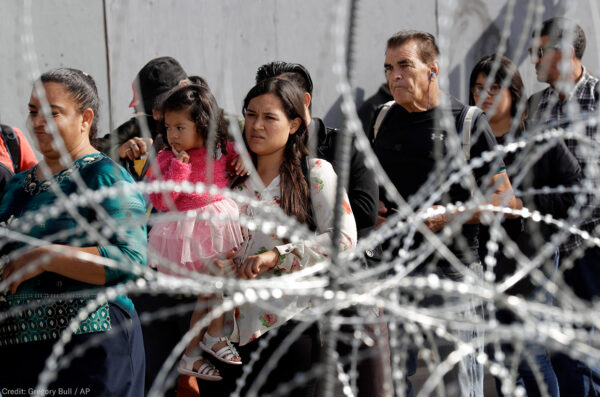
The Ƶ, Southern Poverty Law Center, and Center for Gender & Refugee Studies filed a federal lawsuit challenging the Trump administration’s new policy forcing asylum seekers to return to Mexico and remain there while their cases are considered.
Innovation Law Lab V. Wolf. Explore Case.
U.S. Supreme Court
Jul 2021
Trump Declaring National Emergency

Immigrants' Rights

National Security

Sierra Club v. Trump — Challenge to Trump’s National Emergency Declaration to Construct a Border Wall

In February 2019, the Ƶfiled a lawsuit challenging President Trump’s emergency powers declaration to secure funds to build a wall along the southern border. The lawsuit was filed on behalf of the Sierra Club and the Southern Border Communities Coalition. The lawsuit argues that the president is usurping Congress’s appropriations power and threatening the clearly defined separation of powers inscribed in the Constitution. On January 20, 2021, President Biden halted further border wall construction. Litigation in this and subsequent related challenges has been paused or deadlines extended while the ACLU’s clients and the Biden administration determine next steps.
Sierra Club V. Trump — Challenge To Trump’s National Emergency Declaration To Construct A Border Wall. Explore Case.
U.S. Supreme Court
Jan 2021
Mahanoy Area School District v. B.L.

Free Speech

Mahanoy Area School District v. B.L.

On September 25, 2017, the ACLU-PA filed suit on behalf of B.L., a high school sophomore who has been cheerleading since she was in fifth grade and was expelled from the team as punishment for out-of-school speech.
Mahanoy Area School District V. B.l.. Explore Case.

All Cases

24 Supreme Court Cases during the 2020 Term

Edwards v. Vannoy
U.S. Supreme Court
Dec 2021

Criminal Law Reform

Edwards v. Vannoy

Whether the Supreme Court’s decision in Ramos v. Louisiana, holding that the Sixth Amendment guarantees the right to a unanimous jury verdict, applies retroactively to cases on federal collateral review.
Explore case
Edwards V. Vannoy. Explore Case.
U.S. Supreme Court
Dec 2021
Edwards v. Vannoy

Criminal Law Reform

Edwards v. Vannoy

Whether the Supreme Court’s decision in Ramos v. Louisiana, holding that the Sixth Amendment guarantees the right to a unanimous jury verdict, applies retroactively to cases on federal collateral review.
Edwards V. Vannoy. Explore Case.
Oliva v. Nivar
U.S. Supreme Court
Dec 2021

Criminal Law Reform

Oliva v. Nivar

Whether individuals can challenge the conduct of federal officials engaged in standard law enforcement operations as unconstitutional under Bivens or whether such claims present a new context unless they involve narcotics officers “manacling the plaintiff in front of his family in his home and stripsearching him in violation of the Fourth Amendment,” as the Fifth Circuit held.
Explore case
Oliva V. Nivar. Explore Case.
U.S. Supreme Court
Dec 2021
Oliva v. Nivar

Criminal Law Reform

Oliva v. Nivar

Whether individuals can challenge the conduct of federal officials engaged in standard law enforcement operations as unconstitutional under Bivens or whether such claims present a new context unless they involve narcotics officers “manacling the plaintiff in front of his family in his home and stripsearching him in violation of the Fourth Amendment,” as the Fifth Circuit held.
Oliva V. Nivar. Explore Case.
Jones v. Mississippi
U.S. Supreme Court
Dec 2021

Juvenile Justice

Jones v. Mississippi

Whether the Eighth Amendment requires a judge or jury to make a finding that a juvenile is “permanently incorrigible” before imposing a sentence of life without parole.
Explore case
Jones V. Mississippi. Explore Case.
U.S. Supreme Court
Dec 2021
Jones v. Mississippi

Juvenile Justice

Jones v. Mississippi

Whether the Eighth Amendment requires a judge or jury to make a finding that a juvenile is “permanently incorrigible” before imposing a sentence of life without parole.
Jones V. Mississippi. Explore Case.
Supreme Court
U.S. Supreme Court
Dec 2021

Civil Liberties

Transunion v. Ramirez

Whether 8,185 people who were all falsely labeled terrorists by TransUnion, a credit reporting company, can be represented in a class action consistent with Article III and Federal Rule of Civil Procedure 23.
Explore case
Transunion V. Ramirez. Explore Case.
U.S. Supreme Court
Dec 2021
Supreme Court

Civil Liberties

Transunion v. Ramirez

Whether 8,185 people who were all falsely labeled terrorists by TransUnion, a credit reporting company, can be represented in a class action consistent with Article III and Federal Rule of Civil Procedure 23.
Transunion V. Ramirez. Explore Case.
Brownback v. King
U.S. Supreme Court
Dec 2021

Criminal Law Reform

Brownback v. King

Whether the district court’s dismissal of a Federal Tort Claims Act (FTCA) claim against the United States for lack of subject-matter jurisdiction bars adjudication of simultaneously filed constitutional claims against the individual officers responsible for the plaintiff’s injuries.
Explore case
Brownback V. King. Explore Case.
U.S. Supreme Court
Dec 2021
Brownback v. King

Criminal Law Reform

Brownback v. King

Whether the district court’s dismissal of a Federal Tort Claims Act (FTCA) claim against the United States for lack of subject-matter jurisdiction bars adjudication of simultaneously filed constitutional claims against the individual officers responsible for the plaintiff’s injuries.
Brownback V. King. Explore Case.
23
4
5

How Do Terms Work?

Between October and late June or early July the Supreme Court is “in session,” meaning it hears oral arguments, issues written decisions, and decides whether to take additional cases.

Submitting petitions

Our legal team at the Ƶfiles a cert petition to the U.S. Supreme Court, a type of petition that usually argues that a lower court has incorrectly decided an important question of law that violates civil rights and should be fixed to prevent similar confusion in similar cases.

term starts

U.S. Supreme Court decides to take a case

On average, the Court considers about 7,000 ‐ 8,000 petitions each term and accepts about 80 for oral argument.

Oral arguments

This is the period where the U.S. Supreme Court listens to our case in court.

U.S. Supreme Court makes final decisions

While the U.S. Supreme Court makes decisions throughout the term, many are released right before the term ends. If a decision doesn't go in our favor, we fight back!